The Challenge: Limited Space for Grain Storage
C Réales operates a flat storage facility in Verteuil d’Agenais for wheat, rapeseed, and maize. The building offered a total capacity of 7,000 tonnes, but the filling method prevented full use of the available space.
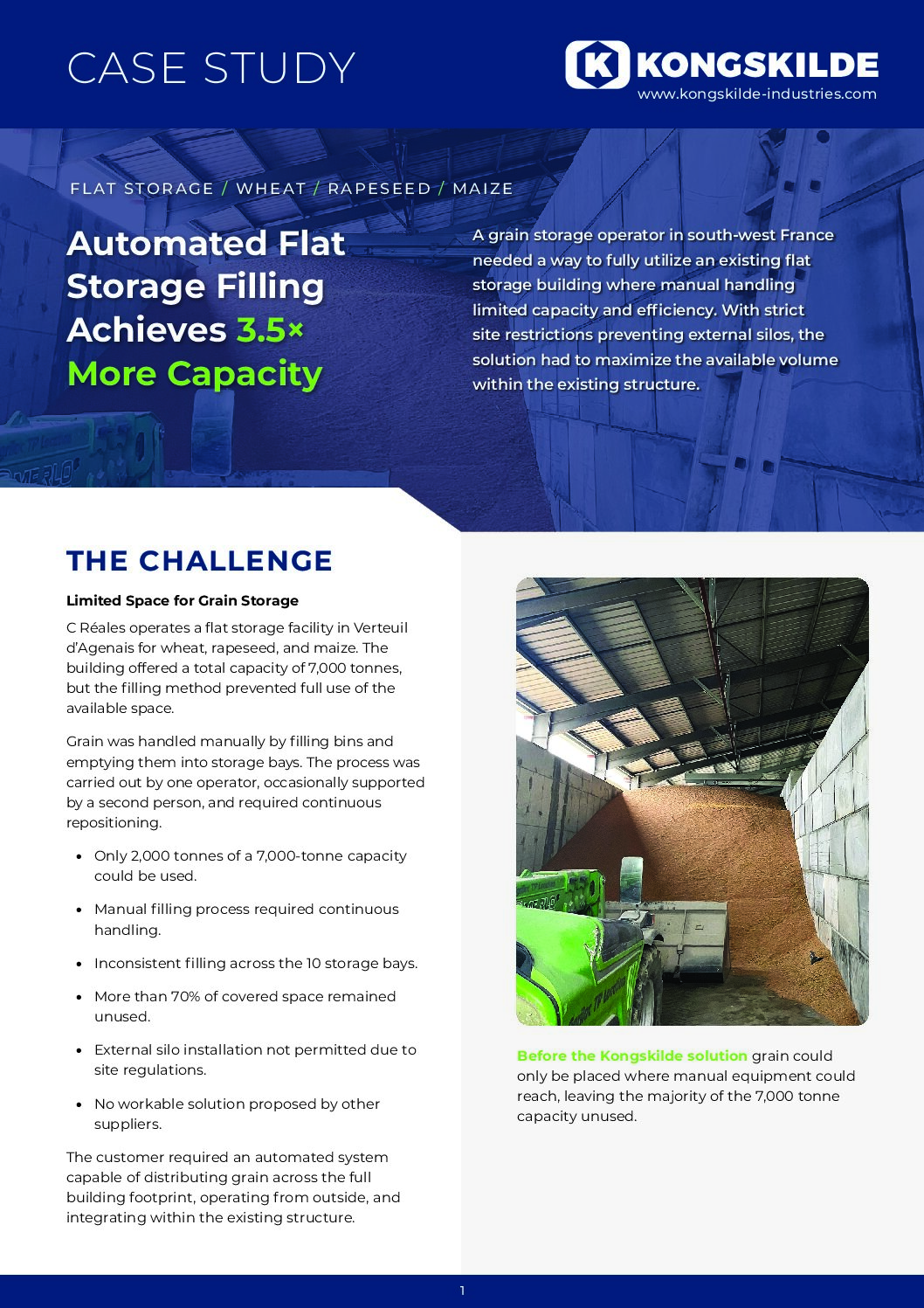
Grain was handled manually by filling bins and emptying them into storage bays. The process was carried out by one operator, occasionally supported by a second person, and required continuous repositioning.
Key Challenges
- Only 2,000 tonnes of a 7,000-tonne capacity could be used.
- Manual filling process required continuous handling.
- Inconsistent filling across the 10 storage bays.
- More than 70% of covered space remained unused.
- External silo installation not permitted due to site regulations.
- No workable solution proposed by other suppliers.
The customer required an automated system capable of distributing grain across the full building footprint, operating from outside, and integrating within the existing structure.

Before the Kongskilde solution grain could only be placed where manual equipment could reach, leaving the majority of the 7,000 tonne capacity unused.
The Facts: Grain Type and System Requirements
The system had to fill the flat storage building divided into 10 independent bays, distributing grain both lengthwise and widthwise from a single intake point located outside the building.
Storage Specifications:
- Grain types: Wheat, rapeseed, maize
- Activity: Reception, storage and shipment
- Storage type: Flat storage, ground-level bulk
- Building dimensions: 60 m × 24 m
- Number of bays: 10 bays, each 6 m × 24 m
- Bay separator height: 5 m (concrete block construction)
- Previous usable capacity: 2,000 tonnes
- Total storage capacity potential: 7,000 tonnes
The system had to be capable of filling each bay independently and precisely, on both sides of the central belt run, without cross-contamination between grain types.

The storage building is divided into 10 bays by 5 meter concrete block separators, and stores wheat, rapeseed, and maize as entirely separate batches.
The Solution: Automated Flat Storage Filling System
Where other suppliers were unable to propose a viable solution, Kongskilde designed and installed a ceiling-mounted automated flat storage filling system, the BCB 60, engineered to maximize the use of the existing building volume.
The system combines longitudinal and lateral conveying to achieve full coverage of the 60 m × 24 m storage area from a single external intake point.
System Configuration
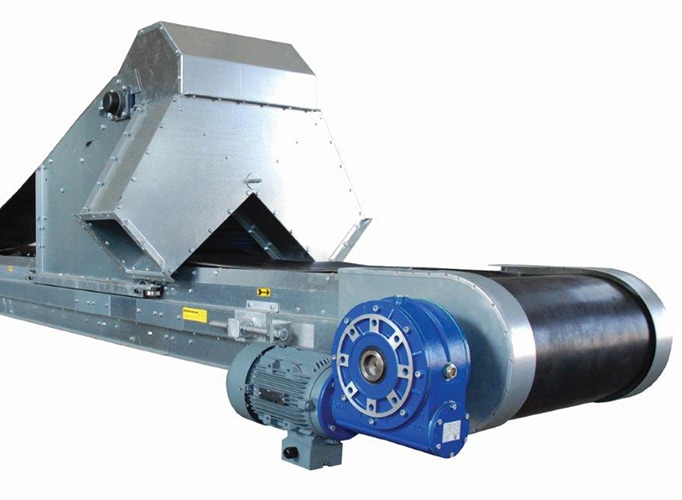
- BCB 60 Belt conveyor (13.66 m), external, positioned at the building entrance
- BCB 60 Belt conveyor (61.18 m), running the full length of the building at ridge height
- BCB 60 Belt conveyor (12.18 m), bi-directional, discharging left and right into each bay
- Gantry (20 m), traveling carriage moving across the building width
- Suspensions, fixed to existing roof rafters, zero floor footprint
Grain is fed from outside into the longitudinal conveyor and carried along the full building length. The bi-directional belt conveyor, mounted on the traveling gantry, then discharges grain left or right into each bay as the gantry moves along the building. By combining this longitudinal movement with controlled lateral discharge, the system deposits grain into each bay automatically and without manual intervention.
Installed at roof ridge height, the system maximizes the available storage volume beneath it, enabling full use of the 7,000-tonne capacity for the first time.
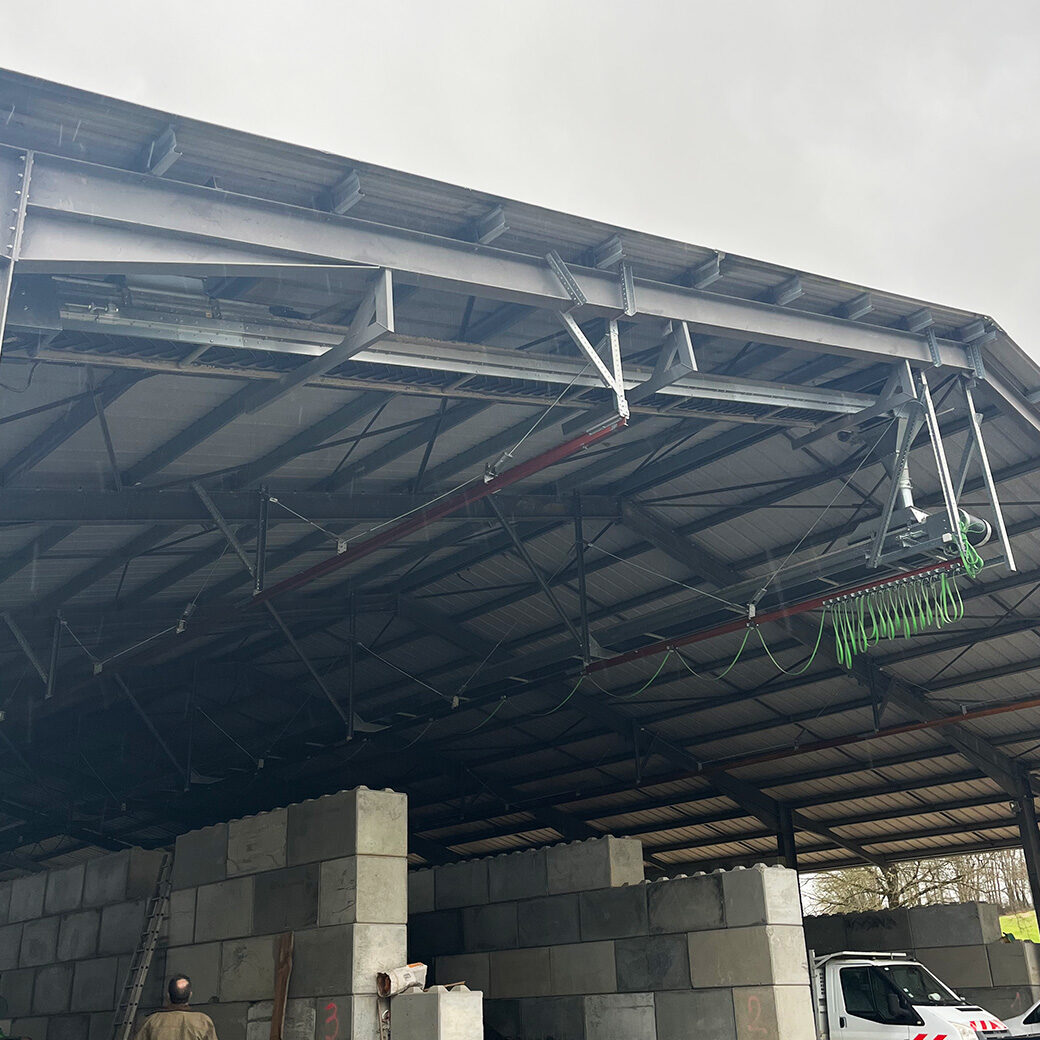
Grain intake from outside the building is routed at roof height.
Advantages & Benefits: Full Use of Available Storage Space
The installation transformed a partially used storage building into a fully optimized asset. By enabling automated grain distribution and unlocking the complete storage capacity, the system improves efficiency, reduces manual workload, and ensures reliable performance during harvest operations.
- Full use of storage capacity: Usable capacity increased from 2,000 tonnes to 7,000 tonnes without structural expansion.
- Eliminated manual filling process: Automated distribution removes the need for bin handling and repositioning.
- Improved harvest efficiency: Continuous filling reduces bottlenecks during peak intake periods.
- Single-operator operation: One operator can manage the entire filling process.
- Clear and accessible storage area: External feeding keeps the building interior free for vehicles and handling equipment.
- Solution adapted to site constraints: Full automation achieved without external silos or structural modifications.
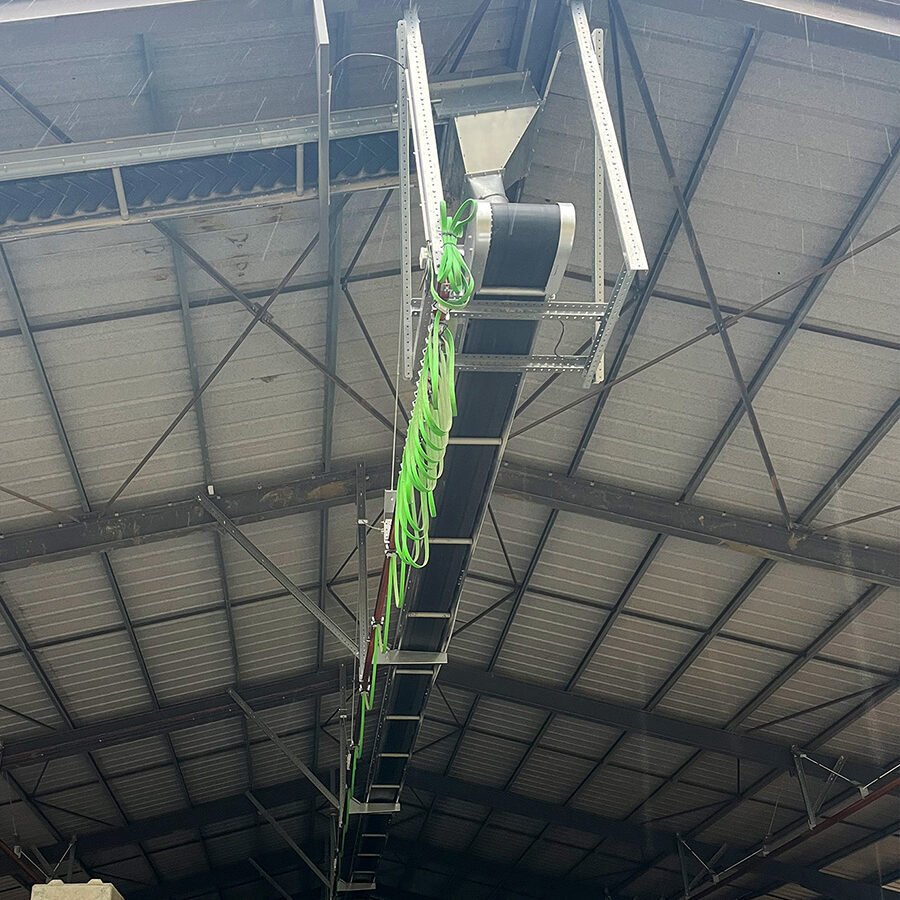
The BCB 60 system deposits grain precisely at any point across all 10 bays automatically, without any operator entering the storage space during filling.
Ready to transform your grain cleaning?
Get in touch to start the conversation and discover how our cleaning solutions can improve your operations.
Download the full case study: