


Key Challenges in Textile and Nonwoven Production
Textile and nonwoven production can generate continuous trim, die-cut matrix, thread waste, off-cuts, and bulky rejects that are difficult to collect and transport consistently. Lightweight materials can quickly fill containers, cling to equipment, and accumulate around high-speed converting lines, while start-up waste can create sudden increases in volume. Without reliable removal, these waste streams require frequent manual handling and can interrupt production flow.
- Continuous waste at high line speeds: Edge trim and matrix waste must be removed without interrupting nonwoven converting, slitting, or die-cutting lines.
- Bulky start-up waste and rejects: Diaper and feminine hygiene lines can generate large volumes of incomplete multilayer products during start-up and production changes.
- Different materials within one product: Nonwoven, cellulose, film, and elastic strands may need to be collected and conveyed together.
- Thread, lint, and fabric off-cuts: Small pieces of sewing waste can accumulate around machines and require frequent manual cleaning.
- Manual transport to waste equipment: Moving loose material in bins requires labour and creates additional traffic around production lines.
- Static and material build-up: Lightweight fibres and flexible materials can cling to surfaces or collect inside improperly designed conveying systems.
Our Textile and Nonwoven Solutions
Kongskilde systems collect lightweight textile and nonwoven production waste at the source and transport it through enclosed pipes to a designated destination. Each system is configured around the material, line speed, waste volume, conveying distance, and available space.
- Continuous Trim and Matrix Removal: Capture edge trim, die-cut matrix, and continuous nonwoven waste directly from converting, slitting, rewinding, and die-cutting lines.
- Start-Up Waste and Reject Handling: Remove incomplete products and multilayer rejects from diaper, feminine hygiene, and other absorbent-product lines without repeated manual handling.
- Pneumatic Conveying to Balers and Collection Areas: Transport process waste from one or multiple production lines directly to a baler, compactor, recycling area, or central collection point.
- Thread and Textile Off-Cut Extraction: Collect thread-chain waste, thread ends, lint, and small fabric off-cuts close to industrial sewing and trimming operations.
- Cutting, Filtration, and Fire Safety: Downsize waste when necessary for reliable transport, filter conveying air, and incorporate suitable fire-protection measures based on the material and facility requirements.
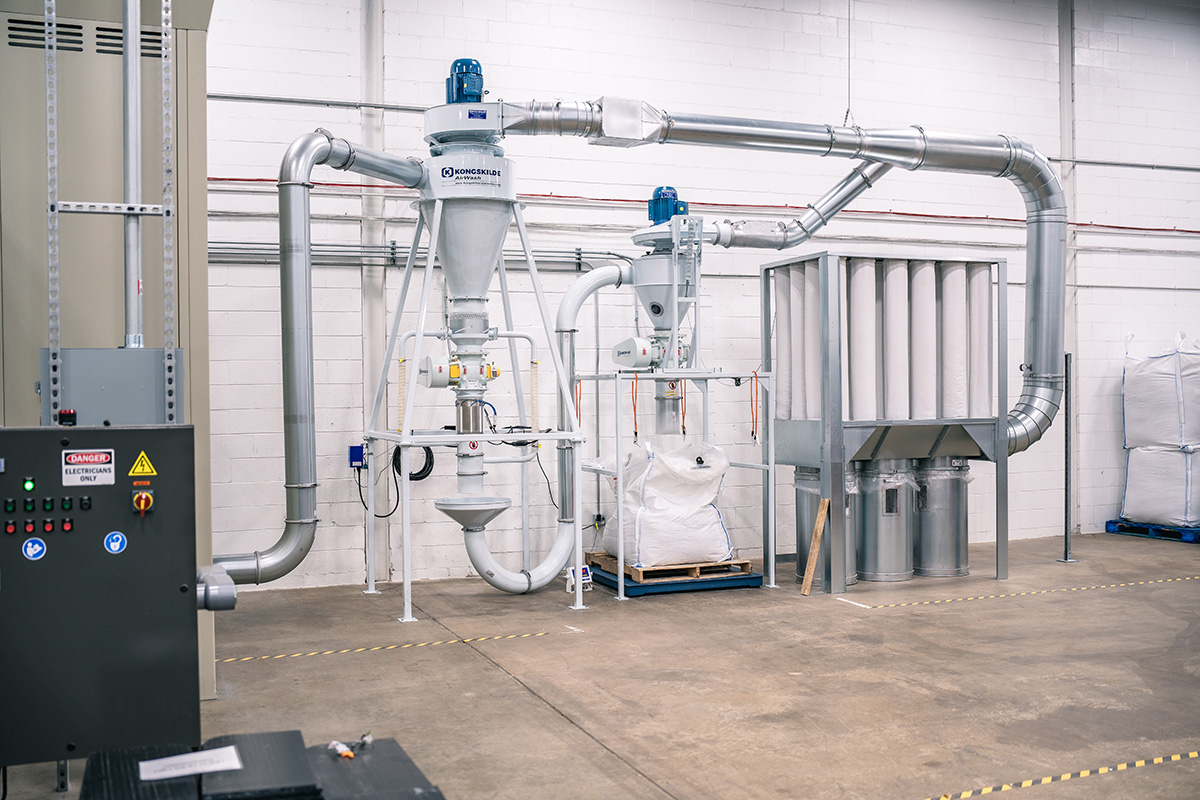

Featured Case Study
Pneumatic Conveying of Wallpaper Trim
A wallcovering manufacturer needed to remove 20 mm paper, suede-textile, and fleece trim from a line running at 120 m/min. Two MultiCutters capture and cut the trim at two pickup points and convey it 120 m horizontally and 10 m vertically to an RVS-5000 separator. A DS 7 filter cleans the air, and fire dampers built for material-carrying pipes support the facility’s fire protection.
Proven Solutions Across the Textile & Nonwoven Industry
We support a wide range of textile and nonwoven producers with solutions tailored to their specific webs, processes, and material handling needs.


Don’t see your application listed?
Don’t worry, we’re up for the challenge. Contact us, and we will find the right solution for your operation.
The Kongskilde Advantage
Our experience across textile, nonwoven, and converting industries becomes a practical advantage for you. From protecting low-density webs to handling high-speed trim extraction with fire safety, we apply proven knowledge to help you solve challenges and achieve reliable results.
Our Guarantee
Every custom system is backed by a full performance guarantee.
Complete Solutions
Fully engineered, installed, and backed by ongoing support from day one.
Your Expert
Expert guidance based on deep process and application knowledge.
Global Support
A worldwide presence backed by regional support.
Start the conversation today.
Every project is different, and so is every custom solution we deliver.
Tell us about your challenges, and one of our experts will follow up to learn more about your operation and discuss how we can help.
- No obligation conversation
- Solutions tailored to your process and materials
- Support for new installations and system upgrades
- Help identifying bottlenecks and improving material flow
- Compact system designs for space-constrained facilities
Frequently Asked Questions
Textiles & Nonwovens | Waste removal
What types of textile and nonwoven production waste can be conveyed pneumatically?
Systems can convey continuous trim, die-cut matrix, punch-outs, nonwoven off-cuts, incomplete hygiene products, thread waste, and fabric scraps. Equipment selection depends on material size, weight, flexibility, composition, and tendency to stretch or compact.
How is edge trim removed from high-speed nonwoven converting lines?
Trim is extracted directly at slitters, rewinders, laminators, or other converting equipment and conveyed through enclosed pipes to collection. Systems are configured around trim width, thickness, strength, line speed, and conveying distance.
How are die-cut matrix and nonwoven scraps removed from converting lines?
Matrix waste, punch-outs, and off-cuts are collected after die cutting and conveyed to a baler, compactor, or collection area. Cutters downsize large or interconnected pieces where needed to support reliable transport.
Textiles & Nonwovens | Hygiene production and textile applications
How can start-up waste from diaper and feminine hygiene production be conveyed to a baler?
Incomplete products and multilayer start-up waste are collected at the end of the line and conveyed to a baler or central waste area, reducing manual handling. Larger products may need cutting before conveying.
How can thread waste and fabric off-cuts be collected in clothing production?
Pneumatic extraction collects thread waste, thread ends, and small fabric off-cuts at production workstations and conveys them to a collection unit. This reduces manual waste collection and helps keep work areas clear.
Textiles & Nonwovens | System design and energy use
Can one pneumatic system collect waste from several textile production lines?
Yes. Systems can collect waste from multiple machines or production lines and convey it to central collection, recycling, or disposal areas. Capacity and routing are matched to the waste materials and machines operating together.
How can pneumatic waste handling systems reduce energy use in textile and nonwoven production?
Producers can reduce energy use by sizing the system to actual waste volumes rather than running an oversized setup. Energy use depends on material characteristics, conveying route, and required capacity. Kongskilde engineers match blowers and components to the application to avoid unnecessary airflow.